We Will Not Be Silenced by William I. Robinson & Maryam S. Griffin
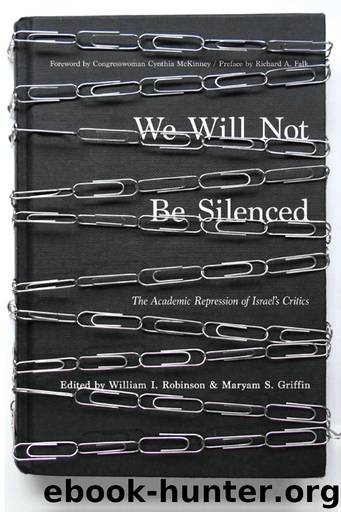
Author:William I. Robinson & Maryam S. Griffin
Language: eng
Format: epub
Publisher: AK Press
7
Hanlon’s Razor Cuts Both Ways
David Delgado Shorter
Editors’ note: David Shorter, Professor and Vice Chair of the Department of World Arts and Cultures/Dance at the University of California at Los Angeles, taught a Tribal Worldviews course in 2012 that focused on indigenous peoples’ use of the media to assert claims to sovereignty. For students’ optional consideration toward completing their final projects, he included on his course website many resources, including the link to a webpage supporting the US Campaign for the Academic and Cultural Boycott of Israel (USACBI) together with several articles opposing the Boycott, Divestment, and Sanctions (BDS) movement. As Professor Shorter discusses in this testimony, for this “crime” he became the target of a sustained investigation by the university and public persecution in violation of the most elemental protocols of academic freedom and of UCLA’s own internal policies.
At the University of California Los Angeles I teach a course called “Aliens, Psychics, and Ghosts” where we explore how the social sciences contribute to the study of the paranormal, or “perinormal” as Richard Dawkins has us consider. The course is quite popular for many reasons, though I want to believe the students are generally interested in a pedagogy that shows them that they should be critical of what they read, what they watch, and even of the professors standing in front of them, including my own course content and perspectives. The course covers alien abduction testimonies, scholarly studies of psychic abilities, and the possibility that consciousness continues after death. Because so much of the scientific method regards determining if evidence is valid, the students and I spend a lot of time discussing “Occam’s Razor,” the principle that among competing hypotheses we should choose the one with fewest assumptions. William of Occam’s original statement was non sunt multiplicanda entia sine necessitate, essentially “let’s not make things overly complex.” In common usage, we could frame it as: among the multiple reasons for any phenomenon, go with the ones that are most reasonable. Such a means of weeding out improbable causes comes in handy when considering how “the paranormal” might be some combination of government conspiracies, human error in perception, as well as entertainment and marketing strategies.
I have also wrestled with Occam’s Razor when attempting to understand the impulses, logic, and stratagems that have plagued me since my administration’s 2012 conscious or unintended collusion with a right-wing, Zionist organization. A couple of administrators, maybe more (one never knows), conspired to appease this organization at the expense of my reputation and academic freedom. Using Occam’s Razor, I would often conclude that as business-minded administrators, they simply thought the cost – academic freedom – was worth the benefit: financial support from pro-Israel donors, regents, and organizations. From a business perspective, such logic is not unimaginable. After all, the only thing hurt is one professor’s reputation and name; the cost is perhaps some criticism from “the left.”
But if their reasoning was simply about business, then Occam’s Razor is less relevant here than an equally useful aphorism sometimes referred to as Hanlon’s Razor: never attribute to malice what can be explained by stupidity.
Download
This site does not store any files on its server. We only index and link to content provided by other sites. Please contact the content providers to delete copyright contents if any and email us, we'll remove relevant links or contents immediately.
| Arms Control | Diplomacy |
| Security | Trades & Tariffs |
| Treaties | African |
| Asian | Australian & Oceanian |
| Canadian | Caribbean & Latin American |
| European | Middle Eastern |
| Russian & Former Soviet Union |
The Secret History by Donna Tartt(19088)
The Social Justice Warrior Handbook by Lisa De Pasquale(12190)
Thirteen Reasons Why by Jay Asher(8910)
This Is How You Lose Her by Junot Diaz(6887)
Weapons of Math Destruction by Cathy O'Neil(6280)
Zero to One by Peter Thiel(5802)
Beartown by Fredrik Backman(5754)
The Myth of the Strong Leader by Archie Brown(5507)
The Fire Next Time by James Baldwin(5446)
How Democracies Die by Steven Levitsky & Daniel Ziblatt(5219)
Promise Me, Dad by Joe Biden(5153)
Stone's Rules by Roger Stone(5088)
A Higher Loyalty: Truth, Lies, and Leadership by James Comey(4964)
100 Deadly Skills by Clint Emerson(4925)
Rise and Kill First by Ronen Bergman(4789)
Secrecy World by Jake Bernstein(4753)
The David Icke Guide to the Global Conspiracy (and how to end it) by David Icke(4720)
The Farm by Tom Rob Smith(4513)
The Doomsday Machine by Daniel Ellsberg(4490)
